Monday, April 27, 2020

Rhubarb Dyeing

Whilst in lockdown the garden has been receiving a lot of attention, especially the areas that have been left unattended for several years. One such patch was the rhubarb bed. The original plants were over ten years old and this year they refused to produce any useable stalks. So up they came and after investigation the roots weren’t even suitable to split and replant they were rotten and woody. So the decision was made to replace with new and I got to chop up the ‘good’ bits for some natural dyeing. I had successfully made a mordant from leaves before but never used the roots. 

After cleaning, peeling and chopping they looked like this.


Next it was time to consult Jenny Deans book ‘Wild Colour’. 

The 600gms roots were brought to a simmer for 30 minutes. 

Meanwhile I prepared fabric. Animal fibres give the best results and although fabric does not require a mordant I chose to mordant my silk habotai and noil with Alum and Cream of Tartar. A piece of 50/50 silk wool mix was not mordanted. 

The wetted fabric was dipped in the dye pots allowing plenty of room for movement of the fabric to ensure an even take up of the dye. The 1st extraction was unfortunately left unattended for enough time to boil which affects the colour changing from a bright yellow to a not unattractive mustard shade. For the second extraction I left the fabric to steep for 8 hours. 


This photograph shows the range of colours I achieved on silk habotai and silk georgette & net, the 4th example is the wool/silk mix. I made two extractions the colour diminishing with each one. Interesting I was able to regain the brightness of yellow with the second extraction. 
The top two were dyed in an extraction from the leaves which were very small. I expected green but again I think they were heated too much. They are, however, a pleasing coffee colour. 
Using iron as a post modifier produced the bottom two olive coloured samples. 


This photograph shows the results on silk noil. Similar comment as above. What an amazing set of colour variation. The one difference here was the piece that I had in my stash that had been previously mordanted in Titanium Oxide, third down, which gave a much deeper brighter yellow. For those who have used Titanium Oxide as a mordant you will know this effect. Again the top two are examples of rhubarb leaves dye but this time I dipped the second one in vinegar. 


This shows the use of iron as a post modifier on three different samples of silk noil. 

Now the samples are collated I know the vat isn’t exhausted yet so I will continue to use it until there is no useable colour left. 


I also post dyed some scarves and gave them a new lease of life. Top is a silk noil scarf and below a crepe de chine scarf both have been warmed up after their dye in rhubarb root.


As a postscript here are the cotton samples I dyed in the rhubarb root. Various types of weave and thickness but all with a pleasant milking coffee finish. The top flowery piece was a surprise. 


If you have found me and are not aware of my Facebook and Instagram pages do pay me a visit for more regular posts.

Instagram. @inspired_textiles
Facebook Inspired Textiles

Thanks for dropping by, it would be great if you left a comment or subscribed. 

Stay safe 


Wednesday, February 26, 2020

Australian stitching project

 It’s been a while since I posted here so here is what’s in my holiday sewing pouch. 

I’m in Sydney on the last lap of our month ‘down under’. 

As I look out over Sydney harbour and the iconic Opera House I am attempting to finish this indigo piece before we travel home. 


I am using up left over pieces of indigo dyed natural fabrics by weaving them, attaching to a base fabric and then slow stitching to hold it altogether.  

I love the variation of colour that can be achieved with different fabrics. I use a synthetic vat, I find it more convenient as I don’t do a lot of indigo dyeing and when I do it is quick and easy to organise. All the threads are natural, cotton and silk. Well known choc ice sticks recycled. 


 I am finding slow stitching is so relaxing and as I listen to some Barbara Streisand I can let the fabric and thread tell me which stitches and tone to use.  If you have liked what you see please hit like and or leave a comment so I know you passed by. 


Friday, August 31, 2018

To view my botanical printing

I have a new blog page dedicated to my botanical dyeing and printing. 

Www.inspiredtextiles.blogspot.com Where I talk in more depth about the processes and techniques.

I also post on Facebook margaretsteeden and Instagram @inspired_textiles where I post regularly my results. 

Hope you can join me on my journey.

Saturday, October 21, 2017

Delivered a range of botanical contact printed silk scarves , cushions and cards to Paul Tavernor gallery in Poynton 

Paul displayed them on a distressed ladder in a corner of the gallery.

Monday, September 05, 2016

Capability Brown - Wallingham

After Eco dyeing a range of natural threads and fabrics I used them in this needle felting landscape to celebrate the anniversary of Capability Browns birthday as part of the nationwide Embroiderers Guild exhibitions. Macclesfield and Glossop EGs came together to display a full range of techniques which is on display at Macclesfield Silk Museum.
This is the view that Lancelot saw each day on his walk to school, no wonder he was inspired to transform the nations landscapes.

Monday, October 26, 2015

Effervescence II

Finished at last and this image shows my piece in situ at textile21's latest exhibition at The Whitaker, Rawtenstall.
The question I got asked the most is 'how did you manage to get it to stand upright?' And every man who studied it had to look around the back. The secret was an acrylic pole.


Here is a closeup of the detail.


Thursday, October 15, 2015

Almost there

Effervescence II is now ready for dyeing. It has been cut out and some surface embroidery added. 
I am at the stage of deciding on the colour of dyes to use. I am leaning towards a cool colour scheme.
Watch this space for more images of the finished dyed piece. 


Thursday, September 17, 2015

Latest work

Been currently working on my latest piece of work for the Textile 21 exhibition in October.
 At the moment it is totally white silk. Both the fabric and thread used.

 It is called Effervescence II and is a development of my silk organza toile that formed part of the "Fashioned in Silk" exhibition of last year.
 

 The circles are the basis of this design and as they overlap they allowed me to develop layers that each display different techniques


I will cut away the outside of the design and then dye with procion dyes so that it will fulfil the brief of the exhibition and be Created in Colour.


Here I am free machine embroidering one of the circles.

Thursday, March 12, 2015

Tech Styles Exhibition now on


At last the Textile 21 exhibition is hung and ready for the first visitors tomorrow.
Below are some closeup a of  three of the exhibits.
The exhibition was first shown in 2013 but there are some new exhibits and extension pieces that are in the shop for sale.


Wednesday, February 04, 2015

Disperse Dyeing, Transfer Printing

 I have really enjoyed revisiting disperse dyes. The colours they give when transferring them to substrates is wonderful. In this instance it was on to pelmet Vilene and when they are coated with a layer of acrylic wax the colours just zing.

I choose to cover the front, back and spine of this Seawhites sketch book after embellishing with stencils and running stitch.

I am into quotes about art by artists at the moment so this is one of my favourites by Vincent.


 I always try to make the back of my covered book as interesting as the front!


Monday, December 29, 2014

Seed Head Cards

A sneek preview of some of latest series of cards that are a development of my TechStyles exhibit.
The background is transfer printed pelmet vilene with free machine embroidery seed heads that were in the grounds of Quarry Bank Mill.


Thursday, May 08, 2014

Cas Holmes workshop

This is very late but wanted to share some images taken on the Cas Holmes workshop back in February at West Dean college, Sussex.

The course was entitled

 'Using the Found - Stitch, Cloth and Memory'

We were encouraged to think green and use what we found and in this instance that was old textiles. old table linen, garments, embellishments etc.

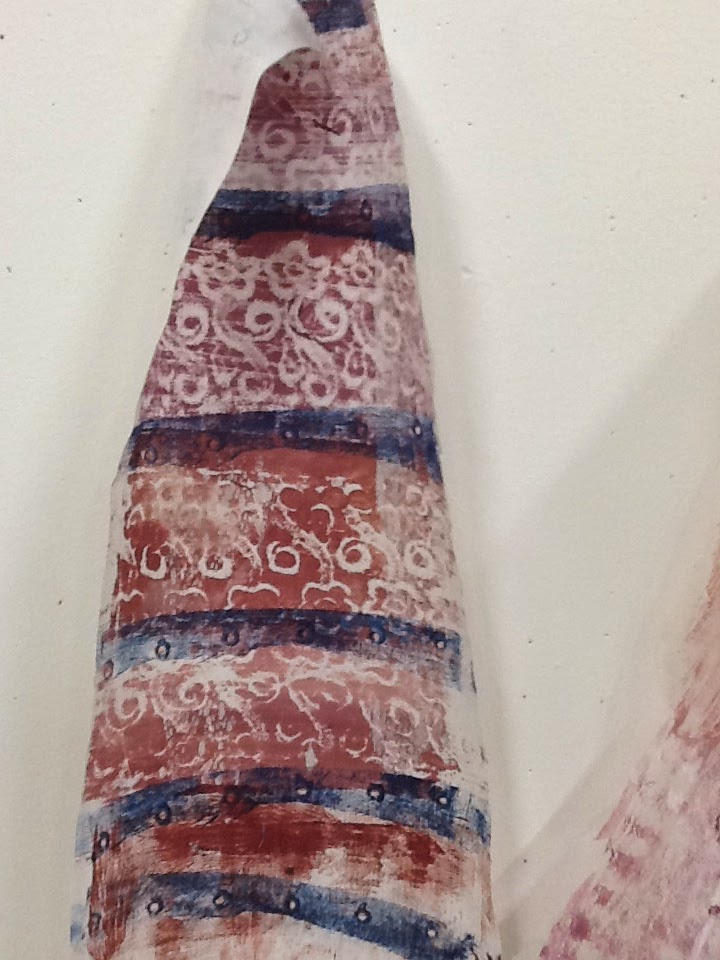
We used all parts of the textiles, hems, cuffs seams in fact anything. We made stamps out of textiles and used stitch and fabric 'mark making' activities.


This is one side of my 'stamp'

Our substrates were old fabrics and paper. After producing an array of both by printing, dyeing or painting we used our stamps to create surface decoration.
This sample clearly shows the use of 'holey' piece of fabric used to print the blue strips. In the burgundy strips I used a high relief piece old lace.


Here this image shows a range of substrates and printing/stamping.

This was my favourite piece.


 It was from all of this that we then produced collages. Cas introduced us to her method of using wall paper paste to adhere the pieces together. Once this was dry I spent a joyful few hours free machine embroidering on top.

This sample used papers, lace that I used as a stamp, fruit tea bag paper.


This was an exercise when Cas gave us some random pieces that we had to incorporate into our collages. I found this challenging as I thought that I knew where I was going but a curved ball like this took us all out of our comfort zone.

 
This is the collage that I did eventually finish and mount. Much happier when in control.
 
 
By the end of the four days I was thinking about what I wanted to achieve in terms of the way I felt about the textiles that I was using rather  than let a technique lead me. This is a new way of thinking in relation to textile art but when I thought about it I have actually used this approach in the past, especially when using old textiles that mean something to me as in this piece entitled 'Memories', it was inspired by a piece of fabric that my mother bought when I was a baby but she never got round to making it up. the salmon colour has always staying with me and it sparked the colour choice for this piece of work.
 
Cas's teaching style is relaxed yet challenging, I thoroughly enjoyed the 4 days.

Thursday, February 27, 2014

Macclesfield Silk Museum Exhibition


Here I am pointing to the free machine embroidery along the hem of my silk toile.

This is the view during the evening of the preview. The lighting helped make the ethereal effect that we wanted to show off the toiles to their best advantage.

There are more images on Textile 21's blog

Wednesday, January 15, 2014

Textile 21 Exhibition


As a member of Textile 21 I have been busy finishing my exhibit which is part of a 16 piece  installation. Fashioned in Silk is a departure for us away from the tradition textile art pictures on a wall exhibition. 16 silk organza toiles display embellishments that reflect members style and expertise. The image above is the one that is to appear in the local press and below a close up of the hem detail of my dress 'Effervescence'.

The circular design flows around the hem and employs free machine embroidery, applique and cable stitch. I used a wide range of silk fabrics.


The exhibition Fashioned in Silk starts 15th February to the 19th April at the Silk Museum, Park lane, Macclesfield, SK11 6TJ. Monday to Saturday 10am-3pm. Free Admission.

In addition we are having a Meet the Artists day on the 29th March as part of the Macclesfield Makers Day event. Roe Street, SK11 6UT. 10am-3pm.
visit our website textile21.co.uk or blog textile21.blogspot.com for further pictures and details.